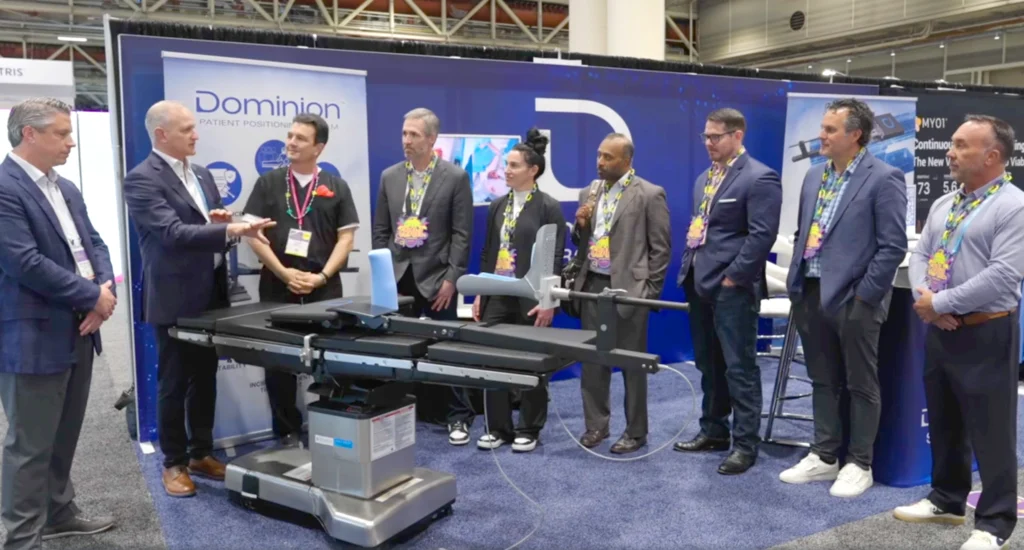
 By Albert Nanni, Chief Executive Officer, Dominion Surgical
I’ve spent much of my professional life in the orthopedic industry. I’ve represented products, worked alongside surgeons, watched technologies come and go, and witnessed some remarkable advancements in patient care.
I’ve also watched our industry become increasingly enamored with technology, sometimes without asking enough difficult questions about what that technology actually delivers.
Let me be clear. I’m not against technology. Far from it. I’ve made a career representing medical devices, and I’m now building a company around an innovative surgical system.
But I’ve always believed that innovation needs to solve a problem. A real problem. And preferably one that surgeons and their teams have actually identified.

Technological Advancement Is Not Clinical Advancement
Somewhere along the way, I believe our industry began confusing technological advancement with clinical advancement.
They are not necessarily the same thing.
What the RACER-Knee Study Found About Robotic Knee Replacement
The recently published RACER-Knee study raises some important questions. In a randomized trial comparing robotic-assisted and conventional total knee replacement, investigators found no clinically meaningful patient benefit from robotic assistance at 12 months, despite the additional cost.1
The trial, published in The Lancet in August 2026, enrolled 339 patients across 10 UK hospitals under the care of 33 surgeons, with both patients and assessors masked to which operation was performed. Robotic knee replacement was more precise, but at one year the two groups reported the same joint awareness, pain, and function. Robotic cases took roughly ten minutes longer and cost more per procedure, and serious adverse events were similar in both arms.1, 2 The study tested one system, in the UK, at one year, so it doesn’t settle the question for every platform. But it does raise the bar.
Does that mean robotic technology has no place in orthopedics? Of course not.
But shouldn’t findings like these cause us to examine how we define progress, how we communicate value, and how much additional cost we are asking the healthcare system to absorb?
There are extraordinarily talented surgeons delivering excellent outcomes using conventional instrumentation. Their experience, judgment, and technical abilities should not be diminished simply because a new technology has entered the marketplace.
And we should be equally careful not to assume that a more expensive procedure is automatically a better one.
The question isn’t whether we can introduce more technology into the operating room. It’s whether we should, and what meaningful value it brings when we do.
Why I Co-Founded Dominion Surgical
That thinking played a significant role in my decision to co-found and launch Dominion Surgical.
When I first encountered the Dominion Patient Positioning System, I wasn’t impressed simply because it incorporated automation. I was interested because it addressed problems I had heard and witnessed surgeons and their teams discuss for years. Or experienced myself, as I was involved in manipulating the tables.
Problems involving control, communication, patient positioning, workflow, and the demands placed on operating room personnel. In direct anterior hip replacement, that means who controls the operative leg, how much specialty equipment the room needs, and how many people it takes to position the patient.
It made sense to me.
That doesn’t mean we get a free pass. We have to demonstrate our value, listen to the people using our system, and continue refining it as we introduce it into clinical practice.
The same standard I believe should apply to every medical device company must apply to us.
Respect the Industry. Keep Asking Hard Questions.
I have tremendous respect for this industry and the people who have dedicated their careers to advancing orthopedic surgery.
But respect shouldn’t prevent us from asking difficult questions.
Sometimes the most meaningful innovation isn’t about adding more technology.
It’s about solving a problem that should have been addressed a long time ago.
Learn how surgeon-controlled positioning fits that standard on the Dominion PPS page, or contact Dominion Surgical to talk with our team.
Related reading: The ASC Isn’t a Smaller Hospital. So Why Are We Treating It Like One?
Albert Nanni
Chief Executive Officer, Dominion Surgical
References
- Robotic-arm-assisted versus conventional total knee replacement (RACER-Knee): a pragmatic, multicentre, participant-masked and assessor-masked, superiority, randomised controlled trial. The Lancet. 2026;408(10558):924-934. Published online August 20, 2026. doi:10.1016/S0140-6736(26)00986-4
- University of Warwick. Robotic assisted knee replacement gives the same patient outcomes as a surgeon only procedure. Press release, August 21, 2026. warwick.ac.uk
Disclaimer: The views expressed are those of the author. This content may include images or information featuring earlier developmental versions of the Dominion Patient Positioning System (PPS) and may not reflect the current state of the device. For the most up-to-date product information, please contact Dominion Surgical directly.